

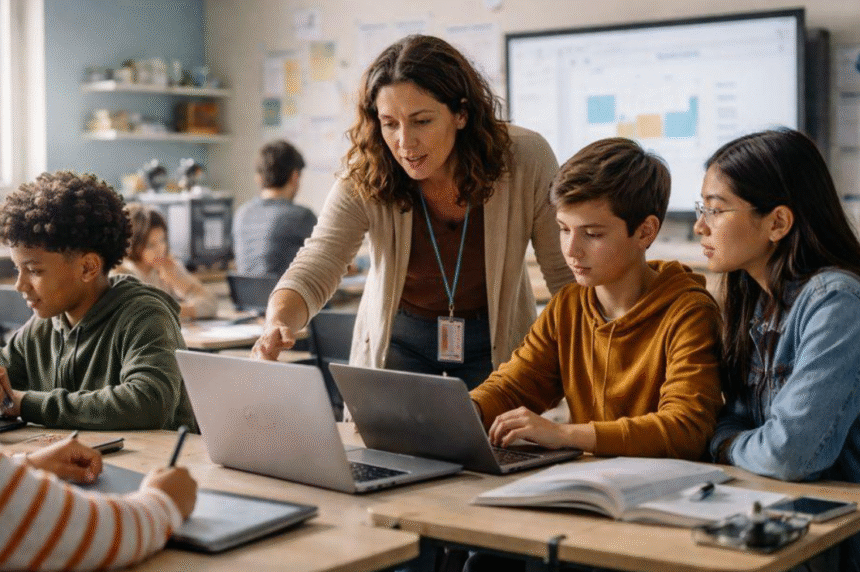
Artificial intelligence is changing the way students learn, teachers teach, and educational institutions manage their daily activities. From personalized learning platforms to AI-powered tutoring tools, technology is creating new opportunities to make education more accessible, flexible, and effective. However, along with these benefits, AI also introduces challenges related to privacy, academic honesty, accuracy, and the role of teachers.
In this blog for Daily Fresh News, we will explore the major benefits and challenges of AI in education, its practical applications, and how it may shape the future of learning.
What Is AI in Education?
AI in education refers to the use of artificial intelligence technologies to support teaching, learning, assessment, and educational administration. These technologies can analyze information, identify learning patterns, answer questions, generate educational content, and provide feedback based on students’ needs.
For example, AI-powered learning applications can help students understand difficult concepts, practice mathematics, improve their writing, or learn a new language. Teachers can also use AI tools to prepare lesson plans, develop quizzes, and organize classroom activities.
Popular AI tools such as ChatGPT, Google Gemini, and AI-powered learning platforms demonstrate how artificial intelligence can support different educational tasks. However, these tools work best when combined with reliable learning materials and guidance from qualified educators.
Benefits of AI in Education
1. Personalized Learning Experiences
Every student learns differently. Some students understand concepts quickly, while others need additional explanations and practice. Traditional classroom teaching can make it difficult to address every student’s individual learning requirements.
AI can help solve this problem by providing personalized learning experiences. Certain educational platforms analyze a student’s answers, progress, and learning patterns to recommend suitable lessons and exercises.
For example, if a student struggles with algebra, an AI-powered platform may suggest additional practice questions or explain the concept using simpler examples. Students who understand the topic quickly can move forward to more advanced material.
This approach can help students learn at their own pace and focus on areas where they need improvement.
2. Instant Feedback and Assistance
Students often have questions while studying independently, but teachers may not always be available to answer them immediately.
AI-powered tutoring tools can provide quick explanations, practice questions, and feedback. Students can use these tools to review lessons, understand mistakes, and explore different approaches to solving problems.
For example, a student learning English can ask an AI tool to explain grammar rules or identify errors in a practice paragraph.
Instant feedback can make studying more convenient. However, students should verify important information because AI-generated answers can sometimes be inaccurate or misleading.
3. Support for Teachers
Teachers spend considerable time preparing lessons, creating assignments, checking assessments, and managing classroom activities. AI can assist with some of these repetitive tasks.
Teachers may use AI tools to:
-
Create quizzes and practice worksheets.
-
Generate lesson plan ideas.
-
Prepare summaries of educational materials.
-
Develop examples for difficult concepts.
-
Draft feedback for student assignments.
-
Adapt learning materials for different ability levels.
By reducing routine work, AI can help teachers dedicate more time to classroom discussions, student support, and interactive learning.
AI should remain an assistant rather than a replacement for teachers’ professional judgment.
4. Improved Accessibility and Inclusive Education
AI can make educational resources more accessible to students with different learning needs and language backgrounds.
Speech-to-text tools can convert spoken words into written text, while text-to-speech technology can read digital content aloud. Translation tools can help students understand materials written in unfamiliar languages.
Other assistive technologies can provide captions, simplify complex text, or support alternative methods of communication.
These features may help students with disabilities and learners who face language barriers participate more effectively in educational activities.
However, accessibility tools must be designed carefully to support diverse needs, including regional languages and students with limited access to technology.
5. Better Learning Resources and Research
AI can help students explore topics, organize information, generate study questions, and summarize lengthy materials. It can also suggest different ways to understand complicated subjects.
For example, a student studying climate change might use an AI assistant to identify key concepts, prepare revision questions, or create an outline for a presentation.
When used responsibly, these tools can encourage curiosity and make independent learning easier.
Students should still consult textbooks, academic publications, teachers, and trusted sources before relying on AI-generated information for assignments or research projects.
6. Efficient Educational Administration
Schools, colleges, and universities handle many administrative responsibilities, including attendance records, scheduling, admissions inquiries, and communication with students.
AI can support certain administrative activities by organizing information, answering common questions, and automating repetitive processes.
For example, an AI chatbot on a university website might explain admission requirements, application deadlines, or course options.
Automation can save time for administrative staff, although sensitive decisions involving student admissions, discipline, or academic progress require appropriate human oversight.
Challenges of AI in Education
Although AI offers several advantages, its use in education also raises important concerns. Educational institutions must understand these limitations before introducing AI tools into classrooms.
1. Risk of Incorrect Information
AI systems can generate answers that sound convincing but contain factual errors. They may misunderstand a question, provide outdated information, or produce explanations that are incomplete.
This creates a particular challenge when students use AI to learn subjects that require accurate facts, calculations, or scientific explanations.
To reduce this risk, students should compare AI-generated answers with textbooks and reliable educational sources. Teachers should also help students develop fact-checking and research skills.
AI can support learning, but it should not be treated as an unquestionable source of truth.
2. Academic Dishonesty and Plagiarism
One major concern is the possibility that students may use AI to complete assignments without understanding the subject.
For example, a student might submit an AI-generated essay as their own work or use an AI tool to solve an entire assignment without attempting the questions independently.
Such practices can reduce genuine learning and make it difficult for teachers to evaluate students’ actual abilities.
Schools and universities can address this challenge by establishing clear AI-use policies, explaining acceptable assistance, and designing assignments that emphasize original thinking, practical application, classroom discussion, and personal understanding.
The goal should be to teach responsible AI use rather than simply assuming that every use of AI is dishonest.
3. Data Privacy and Security
AI educational platforms may process personal information, including student names, learning records, assessment results, and other sensitive details.
If this information is collected or handled improperly, it may create privacy and security risks.
Educational institutions should review the privacy policies of AI platforms before adopting them. They should also limit unnecessary data collection and ensure that students understand how their information may be used.
Students should avoid entering personal details, passwords, private school records, or confidential information into AI tools unless the platform is specifically approved for that purpose.
Protecting student data must remain a priority as educational technology develops.
4. Digital Divide and Unequal Access
Not every student has access to a reliable internet connection, a modern device, or paid educational applications.
Students in rural areas and economically disadvantaged communities may face additional barriers to using AI-powered learning tools.
If schools rely heavily on these technologies without providing alternatives, existing educational inequalities could become more serious.
Governments, educational institutions, and technology providers should work toward affordable access, digital literacy programs, and suitable infrastructure.
AI-based learning should complement traditional educational resources rather than make access to quality education dependent on expensive technology.
5. Reduced Critical Thinking Skills
AI tools can provide quick answers to difficult questions. However, depending on them too frequently may discourage students from solving problems independently.
If students always ask AI to write essays, summarize books, or complete calculations, they may miss opportunities to develop reasoning, creativity, research, and problem-solving skills.
A better approach is to use AI as a learning partner. Students can first attempt a problem themselves, ask AI for hints when necessary, and then explain the solution in their own words.
This method encourages independent thinking while still allowing students to benefit from technological assistance.
6. Less Human Interaction
Education involves more than gaining knowledge. Teachers help students develop communication skills, confidence, teamwork, emotional awareness, and social responsibility.
AI tools can provide information and automated feedback, but they cannot fully replace the human relationships and understanding that teachers bring to the classroom.
Excessive dependence on digital learning platforms may also reduce opportunities for group activities and face-to-face discussions.
Educational institutions should maintain a balance between technology-based learning and meaningful interaction with teachers and classmates.
7. Bias and Unfair Outcomes
AI systems can reflect biases present in their training data or design. As a result, their responses and recommendations may not work equally well for every student.
For example, a system trained mainly on one language or educational context may perform poorly for students using regional languages or following different curricula.
AI-powered assessment and recommendation systems may also produce unfair outcomes if they are not properly evaluated.
Schools should test educational AI tools for accuracy, accessibility, and fairness across different student groups. Important educational decisions should include human review and opportunities to challenge mistakes.
How Can Students and Teachers Use AI Responsibly?
Using AI responsibly requires clear guidelines, practical skills, and a balanced approach to technology.
Here are some useful practices for students and teachers:
-
Use AI to understand concepts: Ask for explanations, examples, and practice questions instead of copying complete answers.
-
Verify important information: Check facts against textbooks, reliable websites, and academic sources.
-
Protect personal information: Avoid sharing confidential or unnecessary personal data.
-
Follow academic rules: Disclose AI assistance when required by school or university policies.
-
Encourage independent thinking: Attempt tasks before using AI and review the reasoning behind its suggestions.
-
Keep teachers involved: Use AI to support instruction, not to replace human guidance.
-
Provide equal opportunities: Ensure students have access to appropriate devices, connectivity, and alternative learning resources.
These practices can help educational institutions benefit from AI while reducing its potential risks.
The Future of AI in Education
The future of education is likely to involve greater collaboration between teachers, students, and artificial intelligence. As AI technologies develop, educational platforms may offer more adaptive learning experiences, improved language support, interactive simulations, and tools that help teachers identify where students need additional assistance.
AI may also support vocational training and lifelong learning by helping people acquire new skills as industries change.
However, technological progress alone will not guarantee better educational outcomes. Schools will need to invest in teacher training, reliable infrastructure, privacy protection, and policies that promote fairness and academic integrity.
The most effective educational systems will use AI where it provides genuine value while preserving the human guidance, curiosity, and critical thinking that make learning meaningful.
Conclusion
AI in education offers significant opportunities to improve personalized learning, provide faster feedback, support teachers, increase accessibility, and simplify administrative tasks. At the same time, challenges such as misinformation, academic dishonesty, privacy concerns, unequal access, bias, and reduced independent thinking require careful attention.
The solution is not to accept every AI tool without question or reject the technology completely. Instead, students and teachers should learn how to use AI responsibly, verify its output, and maintain a strong focus on human learning and interaction.
As artificial intelligence becomes more common in education, a balanced approach can help make learning more effective, inclusive, and accessible.