

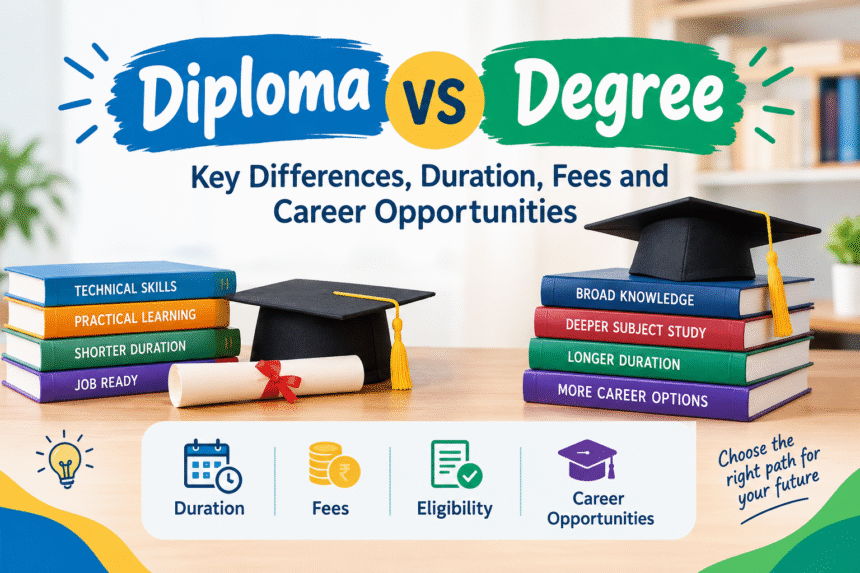
Choosing the right educational qualification is an important decision that can shape your career and future opportunities. Many students completing Class 10 or Class 12 often wonder whether they should pursue a diploma or a degree. Both qualifications can help students develop knowledge, gain practical skills, and prepare for employment, but they differ in duration, course structure, eligibility, and career opportunities.
Understanding the difference between a diploma and a degree can help you choose an educational path that matches your interests, budget, and long-term goals. In this guide, Daily Fresh News explains the major differences between these qualifications and how to decide which option may be suitable for you.
What Is a Diploma?
A diploma is an educational qualification that usually focuses on a particular subject, profession, or technical skill. Diploma programmes are commonly designed to provide specialised knowledge and practical training for specific industries.
Students can pursue different types of diplomas in fields such as engineering, computer applications, healthcare, business management, hospitality, fashion design, and digital marketing. Depending on the programme and institution, admission may be available after Class 10, Class 12, or graduation.
For example, a student interested in technical education may choose a diploma in mechanical engineering or computer engineering after Class 10. Similarly, someone interested in business or technology may pursue a specialised diploma after completing Class 12.
Diploma courses are often shorter than traditional degree programmes. Many last between one and three years, although the exact duration depends on the subject and institution.
The primary advantage of a diploma is its specialised approach. Students can concentrate on industry-related skills and practical learning that may help them prepare for entry-level jobs or further education.
What Is a Degree?
A degree is a formal academic qualification awarded by a recognised university or other authorised higher education institution after successful completion of a prescribed programme.
Degree courses generally provide broader academic knowledge and a deeper understanding of a chosen subject. They may include theoretical studies, practical assignments, laboratory work, projects, internships, and research activities, depending on the discipline.
Popular degree programmes include Bachelor of Arts (BA), Bachelor of Commerce (BCom), Bachelor of Science (BSc), Bachelor of Technology (BTech), Bachelor of Business Administration (BBA), and Bachelor of Computer Applications (BCA).
In India, many undergraduate degrees take three or four years to complete, while some professional programmes have different durations. A master’s degree generally requires an undergraduate qualification and additional study.
A degree can support students who want to pursue professional careers, apply for jobs requiring graduation, or continue their education through postgraduate programmes. However, eligibility depends on the specific course, employer, and applicable regulations.
Diploma vs Degree: Key Differences
Although both qualifications provide educational and career benefits, they serve different purposes. The following comparison highlights their main differences.
| Factor | Diploma | Degree |
|---|---|---|
| Main focus | Specialised knowledge and practical skills | Broader academic knowledge and subject depth |
| Duration | Often 1 to 3 years | Commonly 3 to 4 years for a bachelor’s degree |
| Eligibility | May be available after Class 10, Class 12, or graduation | Usually requires Class 12 for undergraduate admission |
| Course structure | Often concentrated on a specific field | May cover a wider range of subjects |
| Learning approach | Frequently practical and career-focused | Combines theory and practical learning |
| Cost | May cost less overall because of a shorter duration | May involve higher total expenses |
| Employment | Suitable for eligible technical and specialised roles | Can qualify students for graduate-level positions |
| Higher education | Further study depends on admission rules | Often provides a pathway to postgraduate study |
| Career flexibility | Strongest within the selected specialisation | May offer broader options, depending on the subject |
These are general differences rather than fixed rules. Some advanced diplomas are highly specialised, while certain degree programmes are strongly focused on practical training.
1. Difference in Course Duration
Course duration is one of the most noticeable differences between a diploma and a degree.
Many diploma programmes can be completed in one to three years. Polytechnic diplomas in engineering, for example, commonly follow a three-year structure after Class 10. Other professional diplomas may take less time.
Bachelor’s degree programmes usually require three or four years in India, depending on the subject and course structure. Certain professional degrees take longer.
A shorter diploma can help students acquire specialised skills sooner. A degree, on the other hand, generally provides more time to study a subject in depth.
Students should always check the official course details before applying because the duration varies across institutions and qualifications.
2. Difference in Eligibility Requirements
Admission requirements depend on the course, institution, and educational system.
Some diploma programmes accept students after Class 10, making them an option for those who want to begin technical or vocational training early. Other diploma courses require Class 12 or an existing bachelor’s degree.
Most undergraduate degree programmes require successful completion of Class 12 or an equivalent qualification. Certain courses also require specific subjects, entrance examinations, minimum marks, or other admission conditions.
For instance, students applying for engineering degrees generally need to satisfy the relevant mathematics and science requirements. Eligibility for business, arts, and other programmes may be different.
Before selecting a course, students should review the admission criteria and confirm that their previous qualifications meet the requirements.
3. Difference in Fees and Expenses
The total cost of education can influence a student’s decision. Diploma programmes may be more affordable because they often have shorter durations, but this is not always the case.
Fees depend on the institution, location, course specialisation, facilities, and whether the institution is government-funded or privately operated.
Degree programmes may involve additional expenses over a longer period, including tuition, accommodation, transport, books, equipment, and examination fees.
However, an affordable degree at a government college may cost less than an expensive professional diploma at a private institute.
Students should compare the complete cost of each programme rather than judging affordability by the course title alone. Scholarships, financial assistance, and education loans may also be worth exploring.
4. Difference in Learning Style
Diploma courses frequently emphasise practical training and job-specific skills. Depending on the subject, students may work with equipment, software, technical tools, design projects, or industry-related assignments.
This approach can be useful for students who prefer learning by doing and want to develop skills relevant to a particular occupation.
Degree programmes generally offer a more extensive academic curriculum. Students may study foundational concepts, specialised subjects, practical applications, and research methods.
For example, a computer-related diploma may focus on selected programming tools or technical applications, while a computer science degree may cover programming, algorithms, databases, computer networks, and other theoretical and practical subjects.
Neither learning style is automatically better. The right choice depends on the student’s learning preferences and intended career.
5. Career Opportunities After a Diploma
A diploma can provide access to employment opportunities in technical, creative, administrative, and service-related fields.
Depending on the qualification and employer requirements, diploma holders may apply for positions such as:
- Junior technical assistant
- Engineering technician
- Computer support technician
- CAD technician
- Graphic design assistant
- Hotel operations staff
- Skilled trade technician
Practical experience, communication skills, and additional certifications can improve employment prospects in many industries.
However, completing a diploma does not guarantee employment. Employers may require particular technical skills, work experience, registration, or additional qualifications.
Students should research job descriptions in their chosen industry to understand which diplomas are recognised and what employers expect from applicants.
6. Career Opportunities After a Degree
A degree can help students qualify for a wider range of positions, especially jobs that explicitly require a bachelor’s qualification.
Depending on the subject, graduates may explore careers in business, finance, technology, education, science, marketing, administration, and other professional fields.
Examples include:
- Business development executive
- Software developer
- Accountant or finance associate
- Marketing executive
- Research assistant
- Data analyst, where relevant skills are demonstrated
- Graduate trainee
Some careers require postgraduate education, professional examinations, licences, or other specific qualifications. For example, earning a degree alone may not be sufficient to enter a regulated profession.
A degree may also provide a pathway to master’s programmes and certain competitive examinations, subject to the applicable eligibility conditions.
Career success ultimately depends on more than the qualification itself. Skills, work experience, academic performance, networking, and the demand for a particular profession also matter.
7. Which Is Better for Higher Education?
Students who want to continue studying should carefully consider their long-term academic plans.
A bachelor’s degree commonly provides the standard entry qualification for master’s programmes. Graduates can apply for relevant postgraduate courses if they satisfy the subject-specific and admission requirements.
Diploma holders may also have opportunities to continue their education. In some technical fields, eligible diploma holders can apply for lateral entry into the second year of a related bachelor’s programme. Availability depends on the course, institution, and applicable admission rules.
Certain postgraduate diplomas also require a bachelor’s degree for admission.
It is important to understand that a diploma and a degree are not automatically interchangeable. The institution offering the next course or the employer concerned determines whether a particular qualification meets its requirements.
Students should confirm eligibility before enrolling if they intend to pursue higher education later.
8. Diploma vs Degree: Which Is Better for Getting a Job?
There is no single answer because employers recruit according to the responsibilities and requirements of each position.
A diploma may be a suitable option for technical or vocational jobs that prioritise practical abilities and specialised training. It can also help people who want to enter a specific industry without spending several years completing a longer programme.
A degree may be more appropriate for jobs that require graduation or involve broader academic knowledge. It can also support applications for graduate trainee positions and further professional education.
Before making a decision, look at job advertisements in your preferred field. Compare the qualifications employers request, the skills they value, and whether work experience is necessary.
This research can help you choose a programme based on actual career requirements rather than assumptions about which qualification is superior.
9. How to Choose Between a Diploma and a Degree
Consider the following factors before making your final decision.
Your career goal: Identify the type of job you want and check the qualifications required for that role.
Your budget: Calculate tuition fees and other expenses for the entire programme.
Your preferred learning style: Decide whether you prefer specialised, hands-on training or a broader academic curriculum.
Your future study plans: Check whether the qualification will allow you to apply for further education.
Institutional recognition: Confirm that the institution and the specific programme meet the relevant recognition and approval requirements.
Employment opportunities: Research industry demand, starting roles, skill requirements, and opportunities for advancement.
A carefully chosen diploma can be valuable, just as a well-matched degree can open important opportunities. The most suitable option is the one that supports your goals and is recognised for your intended career path.
Frequently Asked Questions
1. Is a diploma better than a degree?
Neither is universally better. A diploma may suit students seeking specialised practical training, while a degree may be preferable for careers requiring graduation or further academic study.
2. Can I get a job after completing a diploma?
Yes. Diploma holders can apply for jobs relevant to their training, provided they meet the employer’s eligibility and skill requirements. Relevant experience and additional certifications can improve their prospects.
3. Can I pursue a degree after a diploma?
Yes, in many cases. Depending on the course and admission rules, diploma holders may qualify for first-year admission or lateral entry into a related bachelor’s programme.
4. Is a degree necessary for a good salary?
Not always. Earnings depend on the profession, experience, technical ability, location, and employer. Some skilled technical careers offer good opportunities to diploma holders, while other positions require a degree.
5. Can a diploma be equivalent to a degree?
Not automatically. Equivalence depends on the qualification, applicable regulations, and the requirements of the institution or employer concerned. Students should verify the specific rules before relying on an equivalence claim.
6. Which option is suitable after Class 10?
Students interested in technical or vocational education may consider a suitable diploma after Class 10. Those who prefer the conventional academic route can continue to Class 12 and then apply for an undergraduate degree.
Conclusion
The choice between a diploma and a degree depends on your career ambitions, financial situation, preferred learning style, and plans for further education. A diploma can offer focused training and a shorter route into certain occupations, while a degree generally provides broader academic study and access to opportunities that require graduation.
Before enrolling, compare course duration, fees, curriculum, recognition, and employment requirements. Choose an institution and qualification that align with your goals rather than assuming one option is always better.
For more informative guides on education, careers, technology, business, and everyday topics, visit Daily Fresh News and explore useful articles that help you make informed decisions.